Reading Your Life Like a Museum
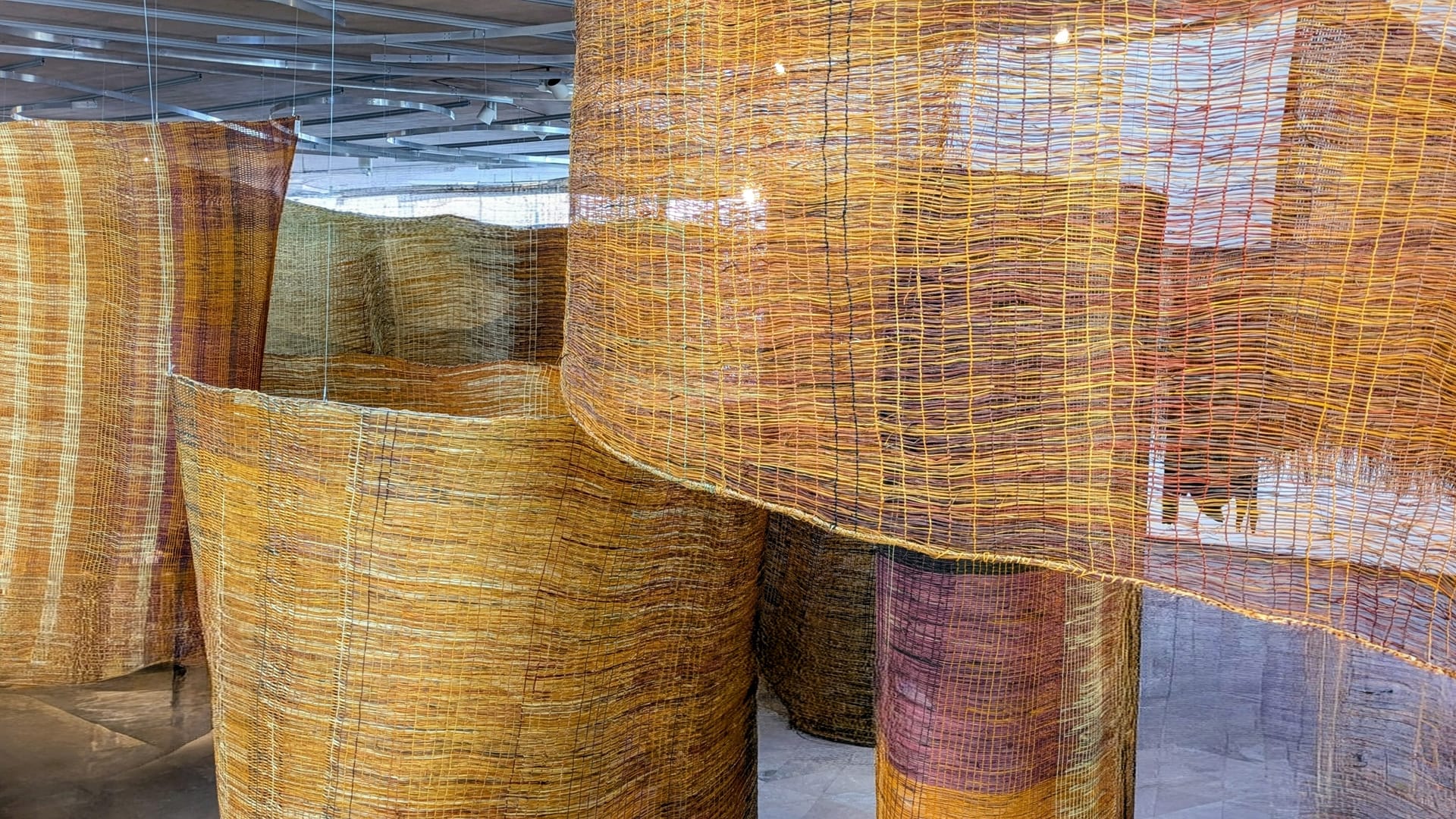
A fishing fence becomes art when you hang it in a museum atrium instead of placing it in water.
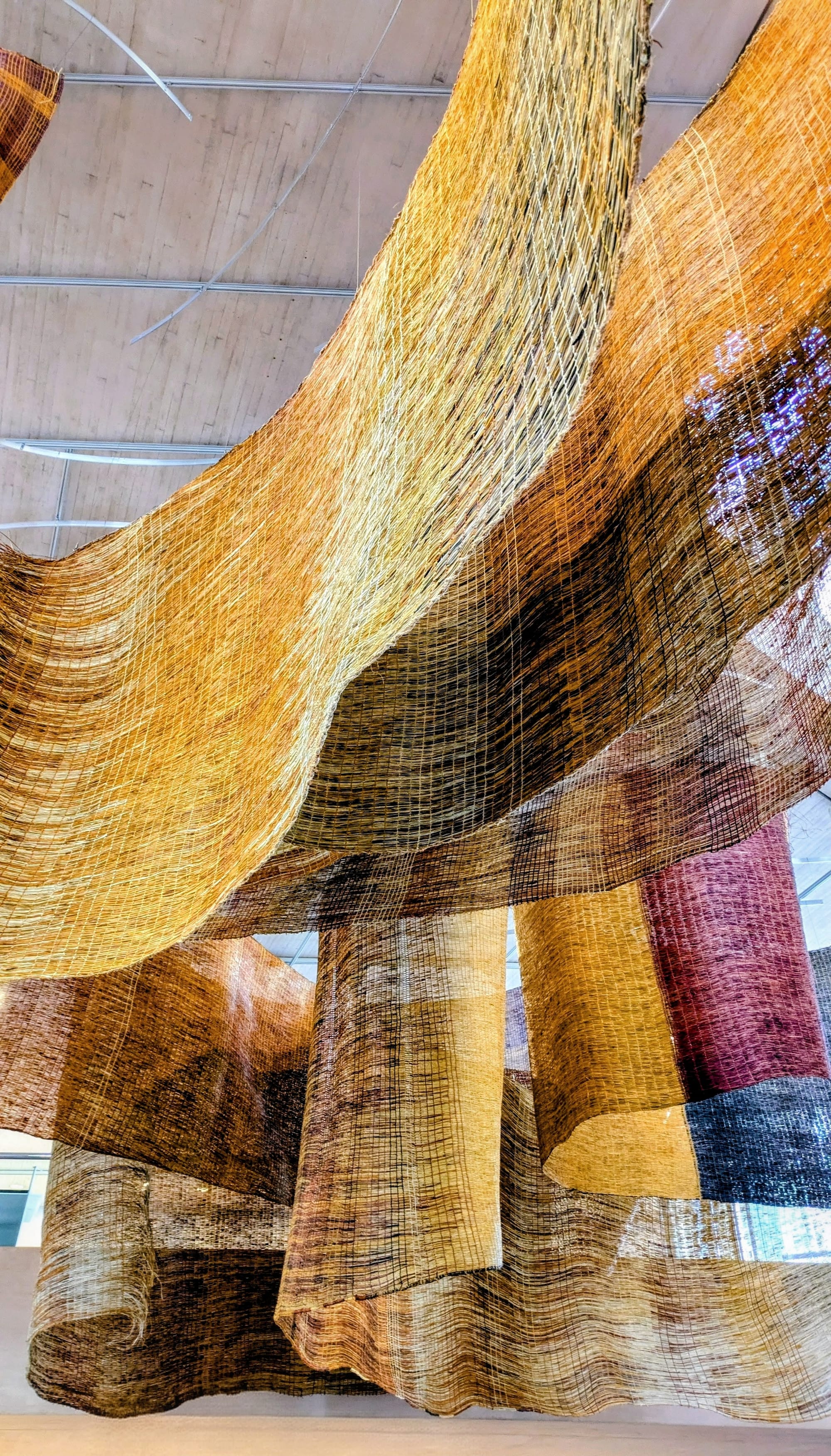
In the National Gallery of Art's East Building, a striking organic form floats in I.M. Pei's soaring atrium—sinuous woven panels in earth tones, suspended near Alexander Calder's mobile. Mun-Dirra. A 100-meter fishing fence reimagined as contemporary art.
For 40,000 years, Burarra people in Australia wove these fences from materials around them—coastal grasses, jungle vines, fibers pulled from rivers—to catch fish in ocean shallows and riverbeds. In the 1980s, traditional fish traps gave way to commercial cast nets. The practice could have died with the last generation who learned it.
Instead, Burarra women kept weaving. Thirteen women created this installation, transforming fishing tools into art. Same river fibers. Same hands working outdoors. Different context, entirely new meaning.
This is what happens at turning points in a life.
Not that the pieces change, but that their arrangement reveals something new. What was functional becomes visible. What was invisible becomes central. The collection stays intact—but the meaning shifts entirely.
Your Life Is a Collection That's Constantly Recontextualizing
Every life accumulates objects, habits, roles, identities, and stories.
You collect:
- Ways of working
- Ways of being seen
- Ways of spending your attention
- Ways of organizing your days
- Ways of explaining yourself to others
Some were chosen deliberately. Many were acquired unconsciously—handed to you by circumstance, family, culture, or survival.
A friend recently described decluttering her apartment: books she'd collected for years, kitchen tools she'd researched carefully, art she'd loved once. Nothing was broken. But walking through her space had started to feel like walking through someone else's life. The collection was still valuable. The arrangement had stopped working.
Like any collection, your life has:
- What's on display (what your energy, time, and identity currently center on)
- What's archived (skills, desires, curiosities you once had but stopped using)
- What's never been fully exhibited (possibilities you sensed but didn't yet know how to display)
A turning point often begins not because something is wrong, but because the arrangement no longer works. The pieces are still valuable. They just need to be seen differently.
The question is: how do you read what's actually reorganizing?
The Art of Seeing Through: Three Lenses for Reading Your Life
The same perceptual tools that help you read museums, culture, and craft can help you read your own life's collection.
The Maker's Eye asks: What choices were made, and what needs to shift?
Looking back at Mun-Dirra: The technique survived because the makers chose to reorganize how it was held, not abandon what it held.
Applied to your life: What skills or ways of being need recontextualization rather than abandonment as you evolve?
The Context Eye: What Forces Shaped This?
The shift from fishing tool to art wasn't random. When modern fishing methods arrived in the 1980s, traditional techniques lost their functional purpose. Without transformation, the knowledge would have died with the last generation who remembered.
Museum commissions and global exhibitions created a new context—a way for ancient practices to remain relevant and valued. The form had to change to meet the moment.
Applied to your life: What external forces shaped your current collection? What's the landscape you've been navigating?
The Personal Eye: What Matters to You?
Despite every transformation—fishing fence to art installation, functional tool to living cultural heritage, men's practice to women as knowledge holders—one thing remained constant: Country.
For Indigenous Australians, Country isn't just land. It's identity woven into landscape, a web of reciprocity. "We belong to Country, rather than Country belonging to us."
What mattered most—connection to Country, collaborative knowledge, stories embedded in every strand—stayed central even as everything else changed form.
Applied to your life: What are you consistently drawn to across all the forms your life has taken?
Reading the Signals: How Turning Points Actually Communicate
One reason clarity feels elusive during transitions is that turning points don't arrive as clear statements. They communicate through friction, repetition, and attraction—often through the body before the mind catches up.
Learning to read these signals is like reading culture—interpreting a language that doesn't announce itself directly.
Friction: When Something Stops Fitting
The first signal is often emotional friction—irritation without a clear cause, boredom where there used to be competence, a sense that you're being misrepresented or overexposed.
Nothing is objectively wrong. The role still works. The relationship still functions. But something feels misaligned.
Friction shows up differently for everyone. One person finds the city they loved—New York, Hong Kong, London—suddenly overwhelming. Crowded. Noisy. The instinct is to leave. But sometimes the signal isn't "leave this place." It's "find a different way to be here."
Friction tells you something needs attention. It doesn't always tell you what.
Repetition: When Themes Won't Leave You Alone
If the same question keeps surfacing—across conversations, books you're drawn to, conflicts that repeat—pay attention.
Turning points often announce themselves through repetition long before clarity arrives. A theme that returns again and again isn't random. It's trying to tell you something.
Attraction: When Your Body Knows First
You might find yourself pulled toward a different quality of life—not a specific job or decision, but a direction: More depth. More coherence. More integrity between inner and outer life.
These cravings get dismissed as impulsive or impractical. But your body often registers transition before your mind does.
Sometimes the signal arrives through unexpected resonance. I once watched people I didn't expect to respond to art stand transfixed at a Dale Chihuly installation—glass sculptures glowing against desert landscape at dusk in Phoenix's Desert Botanical Garden. What struck me wasn't the art itself, but watching perception shift in real time. Bodies leaning in. Stillness. Attention caught.
When you find yourself moved by something unexpected—or unmoved by what once captivated you—that's your perception reorganizing. Your body registers the shift before your mind names it.
Spatial discomfort in places that once fit. A pull toward different environments, different pacing, different kinds of silence. These aren't distractions. They're your nervous system signaling reorganization.
Understanding transitions begins by interpreting these attractions, not suppressing them.
Practicing Clarity as a Skill: What to Do at Turning Points
When you notice the signals—friction, repetition, new attractions—the pull is to force resolution. To decide. To know.
But the space between "something's shifting" and "I know what to do" is where the reorganization happens. Not immediately. Not neatly. Gradually, as you create room for new arrangements to emerge.
Navigate the Liminal Space
Notice without forcing. Friction doesn't mean failure. It means something's outgrown its current form. You don't need to fix it immediately. You need to see it clearly.
Track what repeats. Keep a simple record of what keeps surfacing—questions, themes, pulls. Patterns become visible over weeks and months, not days.
Follow small curiosities. If you're drawn to something—a topic, a place, a different way of working—explore it without commitment. Give yourself permission to research without deciding.
Create space for unexpected arrangements. The collection reorganizes when you stop defending the current display and start noticing what wants to move.
When You're Ready to Interpret
The Three Lenses help you read what's already reorganizing:
The Maker's Eye shows you what's been built and what wants to shift. The Context Eye shows you what's landscape versus what's choice. The Personal Eye shows you what's stayed constant across every form.
When you can see your life through all three lenses, reorganization becomes possible.
Where Clarity Sessions Fit
If you're sensing a transition, Clarity Sessions at The Vantage Room help you practice the art of seeing through—reading what's reorganizing in your life the way you'd read culture.
You'll use The Three Lenses to interpret your life's collection:
- What's been built and what wants to shift
- What forces shaped your current arrangement
- What's stayed constant across every form
Not by telling you what to do—but by helping you see what's already there.
When you can read your own signals, turning points stop feeling muddled. They become invitations to reorganize toward what feels more true.
Subscribe for essays that change how you see.